
August 7, 2026
Dog Grooming Prices: What to Charge and How to Price for Profit
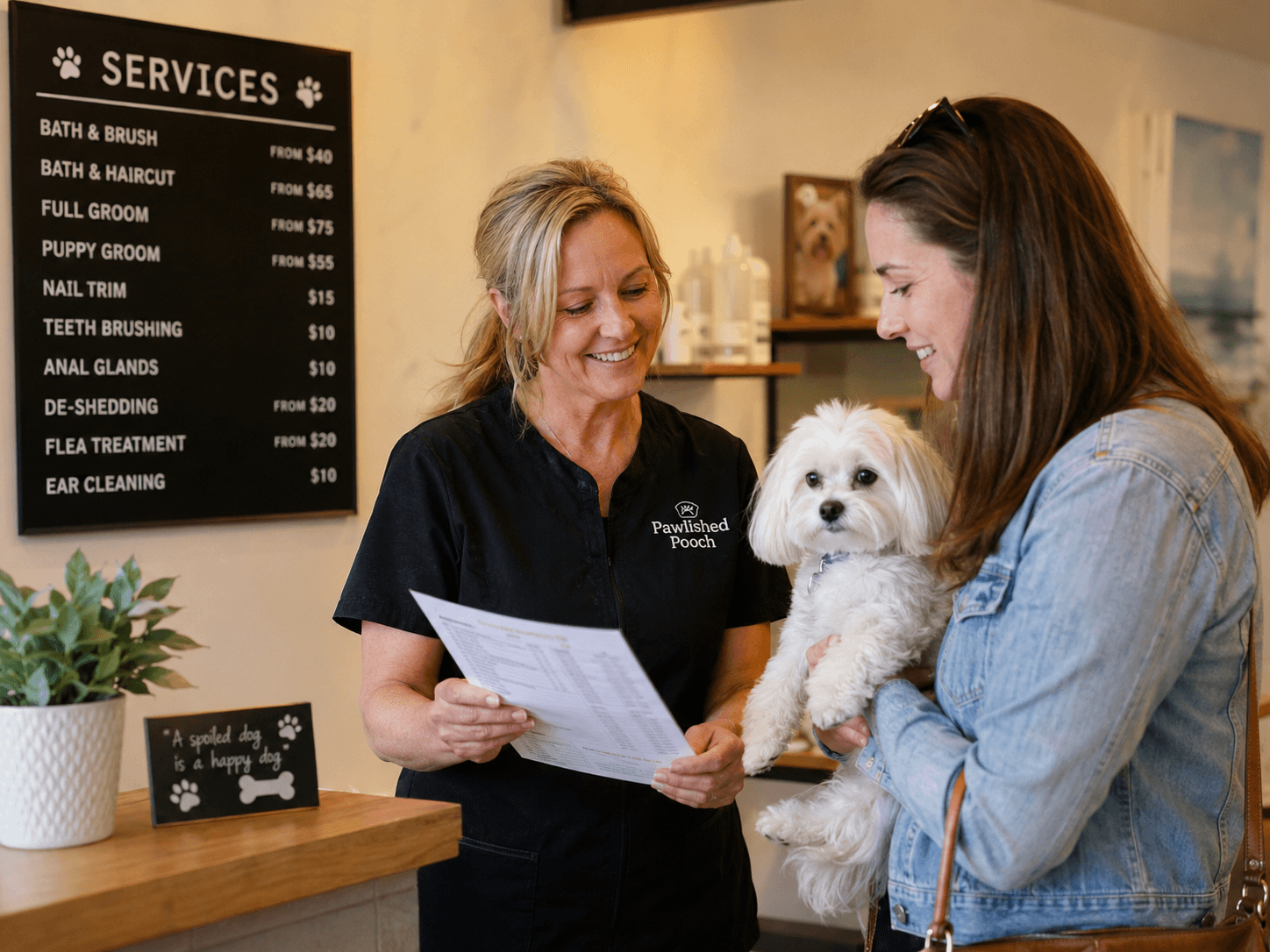
Ask ten groomers what they charge for a full groom on a doodle and you will get ten different answers, sometimes $60 apart. Most groomers set prices the same way: they check what the shop down the street charges, knock a few dollars off to stay competitive, and then wonder why they are exhausted and broke at the end of every month.
Your competitor's prices tell you nothing about your costs, your speed, or your skill. This guide gives you current benchmarks for what dog grooming costs across the U.S., a clear way to price doodles, the break even math that sets your minimum, and scripts for the part everyone dreads: raising prices. If you want the numbers done for you, open the free grooming price calculator in another tab as you read.
Average Dog Grooming Prices
Prices vary by region, but these are realistic ranges for most U.S. markets. A full groom includes the bath, dry, brush out, haircut, nails, and ears. A bath and brush skips the haircut.
Dog size | Full groom | Bath and brush |
|---|---|---|
Small (under 25 lbs) | $45 to $80 | $25 to $55 |
Medium (25 to 60 lbs) | $65 to $110 | $35 to $70 |
Large (60 to 100 lbs) | $85 to $140 | $50 to $90 |
Giant or heavy coated (100+ lbs) | $120 to $200+ | $70 to $120 |
Three things push prices beyond these ranges:
Curly and doodle coats usually run 20 to 40 percent above the size based rate, because they take far longer on the table (more on that below).
Mobile grooming commands a 20 to 40 percent premium for door to door convenience and one on one attention.
Major metro areas run 20 to 40 percent above national averages, and rural markets run lower.
If your prices sit at the bottom of these ranges and you are fully booked, you are leaving money on the table every single day.
Common add on prices
Add on | Typical price |
|---|---|
Nail trim or grind | $10 to $25 |
Teeth brushing | $10 to $15 |
Deshedding treatment | $15 to $40 |
Dematting | $15 to $30 per 15 minutes |
Flea or medicated bath | $15 to $30 |
Specialty shampoo or skin treatment | $10 to $25 |
Anal gland expression | $10 to $15 |
Two add ons per appointment can add thousands of dollars a year for a solo groomer.
The Golden Rule: Price by Time, Not by Dog
The most reliable pricing model in grooming is simple arithmetic:
Your hourly target × the time the groom really takes = the price.
Decide your target, say $60 for every hour of table time.
Time your grooms honestly, including check in, cleanup, and notes.
A 90 minute groom at a $60 hourly target is a $90 minimum.
If a breed or coat consistently runs past its time slot, the price is wrong, not the dog. This is also why weight alone fails: a 25 pound cockapoo in a full curly coat can take twice as long as a 60 pound Lab, and if you price by the scale, the Lab ends up subsidizing the cockapoo.
How to Price Doodles Fairly
Doodles are where most groomers lose money, and where most pricing arguments start. A doodle coat routinely takes 50 to 100 percent longer than a short coated dog of the same size: 60 to 90 minutes of clipper and scissor work versus 30 to 45 for a smooth coat. Price for that time openly and doodle owners will accept it, because they are used to it.
Give doodles their own tier
Build a doodle and poodle mix tier by size instead of folding them into your standard menu:
Mini doodles (under 30 lbs): start around your large dog price.
Medium doodles (30 to 50 lbs): $100 to $150 in most markets.
Standard doodles (50 lbs and up): $130 to $200 or more.
Then check each tier against your hourly target. A standard doodle that takes 150 minutes at a $65 hourly target needs to be at least $162, before supplies.
Price the coat condition, not just the dog
The same doodle costs you very different amounts of time depending on how it arrives. A coat groomed every 4 to 6 weeks stays in maintenance range. Past about 8 weeks, matting sets in and the groom gets slower, riskier, and harder on the dog. Spell this out:
A maintenance price for doodles on a 4 to 6 week schedule
A matting charge by severity or by time, commonly $1 to $2 per minute of dematting
A clear shave down policy when a coat is too matted to brush out humanely
Publishing the policy up front protects you from the awkward doorway negotiation, and it gives owners a real reason to rebook on schedule.
The Break Even Math Every Groomer Should Do Once
Pricing is not a feeling. It takes ten minutes:
Add up monthly overhead: rent or booth fee, insurance, utilities, software, marketing, and loan payments. Say $2,500.
Add supplies per dog: shampoo, blades, and consumables typically run $5 to $8 per dog.
Decide your target income: say $5,000 a month before taxes.
Divide by realistic capacity: at 6 dogs a day and 22 days a month, that is 132 dogs.
($2,500 overhead + $5,000 income) ÷ 132 dogs = a $57 minimum average ticket before supplies. Add the per dog cost and a cushion for no shows and slow weeks, and your real target is $65 to $70.
If your average ticket today is $50, no amount of working harder closes that gap. Only pricing does. The grooming price calculator runs this math with your own numbers and suggests a price for each size.
Build a Price List Clients Understand
Three service tiers
Bath and brush: wash, dry, brush out, nails, ears
Bath and tidy: everything above plus face, feet, and sanitary trim
Full groom: everything above plus a full haircut and style
Three tiers is the sweet spot. Clients understand it instantly, and it creates a natural upgrade path. A shorter, gentler puppy intro groom priced to win a lifelong client is a smart fourth option.
Surcharges that protect your margin
Publish these clearly and apply them without guilt:
Matting: priced by severity or time, because dematting is skilled, risky work
Behavior or handling: for dogs that need a second set of hands, breaks, or extra time
Flea treatment: covers product and salon sanitation
Late cancellation and no show: typically 50 to 100 percent of the service, backed by a card on file
Sell add ons at booking, not checkout
Named packages ("Bath," "Full Groom," "Spa Day") outsell long a la carte menus, because clients naturally pick the middle or top option. And when online booking offers add ons as the client books, they opt in before they ever walk through the door.
Should You Publish Your Prices?
Yes, at least starting prices. A published price list prequalifies clients, cuts down the endless "how much for my dog?" messages, reduces sticker shock at pickup, and helps your local search results, because owners searching for grooming prices near them land on pages that answer the question.
Publish ranges, not absolutes ("small breed full groom from $55"), and note that coat condition and behavior can change the final price.
How to Raise Your Prices Without Losing Clients
The fear is universal. The mass exodus almost never happens, because clients stay with the groomer who knows their dog. If you are booked out three weeks or more, you are underpriced.
Raise every year, in small steps
A predictable $5 to $10 increase, or 8 to 12 percent, once a year is nearly invisible. A $25 correction after four frozen years feels like an event. For scale: a groomer doing 120 grooms a month at an $80 average who raises prices 10 percent adds about $11,500 a year, even if a few price sensitive clients leave.
Give notice, keep it short
Give two to four weeks of notice in one or two sentences, by sign and in your reminder messages: "Starting March 1, my full groom prices will increase by $5. Thank you for trusting me with your pups." No apology paragraph. Apologizing invites negotiation.
Grandfather strategically
If a handful of long term clients on fixed incomes worry you, quietly hold their rate. Raise everyone else. The clients who leave over $5 tend to be the same ones who haggle, no show, and never tip, and their slots refill at the new rate.
Protect the Revenue You Already Booked
Your price list is only half of pricing. The other half is keeping the appointments you have:
No shows are unpaid grooms. Automatic text and email reminders with a one tap confirm, plus deposits or a card on file, are the fix. See our full guide on stopping no shows.
Empty gaps are silent losses. Rebooking every client at checkout keeps your calendar dense.
Untracked add ons vanish. If add ons live in your head instead of your checkout, they do not get charged.
Furbello turns your pricing into something that enforces itself: weight tiers, breed overrides for doodles and double coats, per pet pricing for the dogs that always run long, add ons at booking, and card on file no show protection. See the plans.
Your Pricing Checklist
Calculate your true break even average ticket
Create coat type tiers, including a doodle tier, not just size tiers
Set and publish a dematting charge and a shave down policy
Build three named packages with add ons in the upper tiers
Put an annual price increase on your calendar
Track your average ticket monthly and compare it to your target
Groomers who price on math book fewer dogs and earn more per day. If you are still deciding whether to go independent, see how much dog groomers make and how to start a dog grooming business.
FAQ
How much should I charge for dog grooming?
Start from your break even math, not your competitors: (monthly overhead + target income) ÷ monthly dog capacity is your minimum average ticket. For most U.S. markets, full grooms range from about $45 for small dogs to $200 or more for giant and heavy coated breeds, and most solo groomers land at $60 to $80 per full groom.
How much is a full groom for a small dog?
Nationally, small breed full grooms run about $45 to $80, with curly coated breeds like Shih Tzus and Bichons at the higher end.
How do I price doodles fairly?
By time. Doodle coats routinely take 50 to 100 percent longer than similar sized dogs, so give them their own tier by size, price the coat condition, and publish a matting and shave down policy.
Should groomers charge extra for matted dogs?
Yes. Dematting is slow, skilled, higher risk work. $1 to $2 per minute of dematting is a common standard, and publishing the charge encourages brushing at home.
Should mobile grooming cost more than a salon?
Yes. Door to door convenience, one on one attention, and drive time justify a 20 to 40 percent premium in most markets.
How often should I raise my grooming prices?
Once a year, by a small predictable amount, with two to four weeks of notice. Small yearly increases keep clients far better than large overdue jumps.
Should I charge a no show fee?
Many groomers now require a card on file with a clearly stated no show or late cancellation fee. Paired with automatic reminders, it nearly eliminates the problem.
Price Like a Professional
Your prices are a statement about the quality of your work. Set them from real math instead of fear, publish them clearly, raise them a little every year, and let a full calendar do the rest. When you are ready to put your new prices to work with online booking, reminders, and no show protection, try Furbello free.